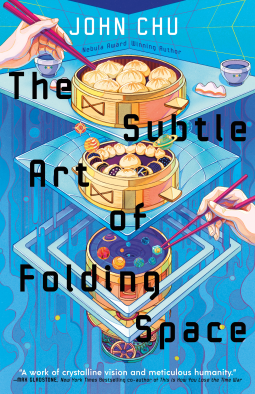
Author: John Chu
Genre: Science fiction, LGBTQ rep, character drama, general fiction, BIPOC rep, Own voices
Publisher: Tor Publishing Group
Format: Ebook (NetGalley Copy)
Release Date: April 7th, 2026
TW: familial abuse, death of a family member (on page) attempted suicide (in the past, off page), funerals, mourning
I encourage my readers to also seek out Chinese and gay reviewers, as although I am a part of the queer community, I am an asexual white woman, and may miss some cultural nuance.
This book had an amazing premise, but had a few missteps in characterization and for lack of a better term, sci-fi believably. But first, the plot:
Behind our universe are the pipes that maintain it (the Skunkworks). Each pipe in the Skunkworks is a law of the universe. The framework of our universe needs constant work, and repair to keep it from deteriorating. Ellie is one of these maintainers, along with her homicidal sister Chris. Their mother, who was one of the best maintainers in the planet, is dying. When Ellie finds out that someone is keeping her mother alive by kitbashing a workaround in the physics of the universe, it's up to her to choose what to do about it. Her choice will reverberate across the inner workings of the universe and more importantly her family. Will she be able to survive her choice? Will her sister ever stop trying to kill her?
I loved the premise of this book. The concept of a whole secret group of people who keep the universe from breaking down by fixing the very laws of the universe. Each maintainer interacts with the Skunkworks differently and each way that they interact with them is unique to them. (For example, Ellie's cousin Daniel sees the schematics as food that he can taste and readjust.) This has great potential for characterization and conflict that the current novel barely scratches the surface of.
I only wish that other aspects of this book were as strong. Firstly, the characterization in this novel felt off. Our main character, Ellie, is fine, however she clearly doesn't realize that she's been abused. She excuses her sister's abuse constantly and that can be hard to read for some. Also, her relationship with Daniel, a major supporting character/deuteragonist, raises a few eyebrows. She always describes Daniel as some variation of 'built like a fridge but surprisingly graceful' every time she sees him. Every time. It comes off oddly as they are cousins, and are not supposed to be romantic.
Other than that mischaracterization, the sci-fi is a bit fuzzy. There is lip service paid to things like general relativity and quantum mechanics, but the way that both characters interact with the Skunkworks feels more like a fantasy. The jargon-laden explanations don't help with this feeling, and after parsing it, don't make sense. So be aware as a reader.
Despite my criticisms, I enjoyed this novel, and will be eagerly looking out for a sequel. If you let the science wash over you, and can look over some raw characterization, you'll love this book.
Thanks to NetGalley and the publisher for the ARC!
Final rating: 4 stars
Drink paring: Green tea brewed grandpa style, for fixing the universe on the go